For centuries, illustrations have played an important role in storytelling. From classic fairy tales to children's books and fantasy novels, artwork helps readers visualise the worlds described in text.
But most modern ebooks contain no illustrations at all. Creating artwork for every scene in a book has traditionally been too expensive and time-consuming.
Today, advances in artificial intelligence are beginning to change that.
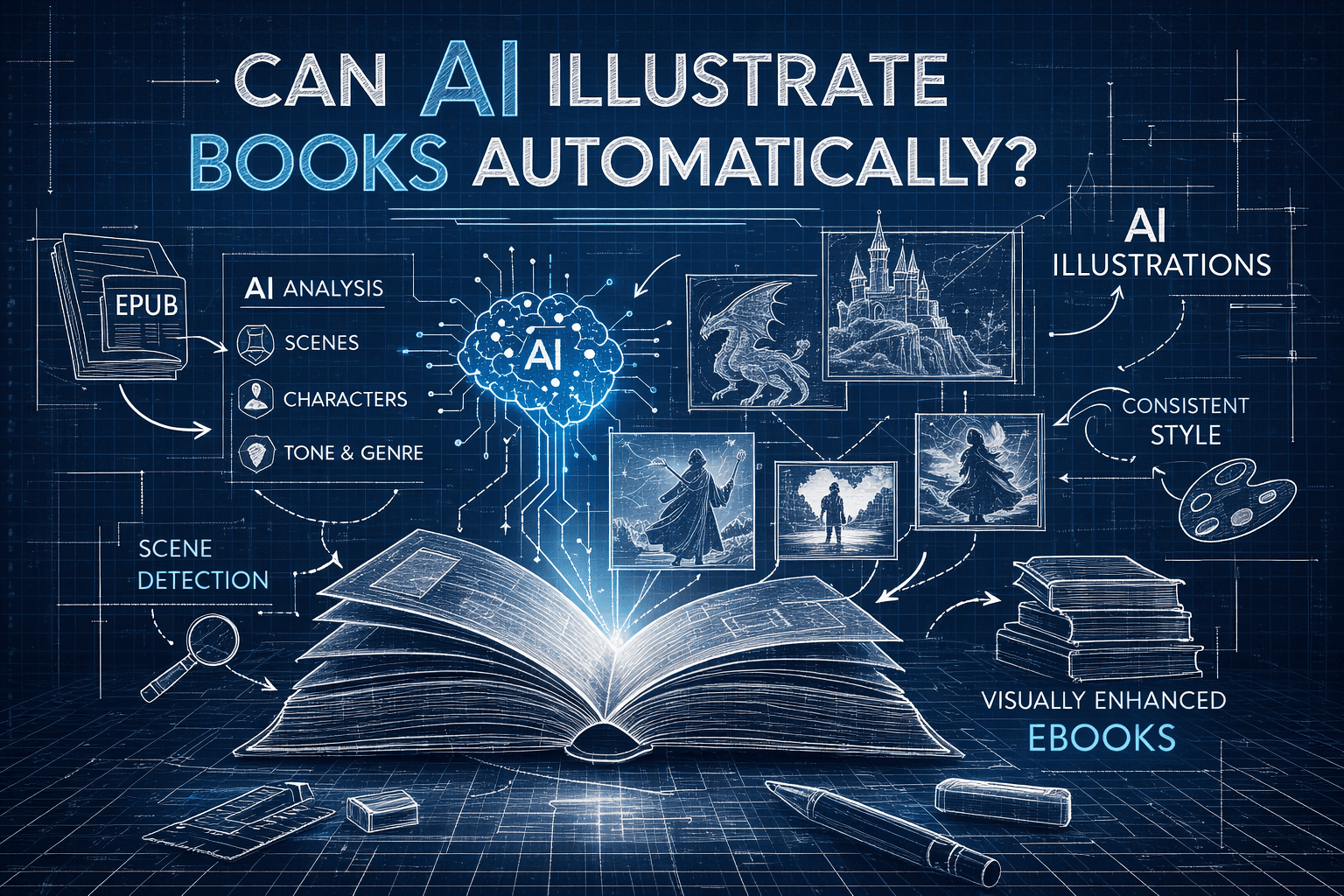
AI can now analyse written stories and generate images that match the narrative. This raises an interesting question:
Can AI illustrate books automatically?
The answer is increasingly yes.
Why Most Books Don't Have Illustrations
Traditional book illustration is a labour-intensive process. A professional illustrator must read the manuscript, identify key scenes, and create artwork for each one.
For a novel with dozens of important moments, this could require weeks or even months of work.
Because of this cost, illustrations are usually limited to:
- Children's books
- Special edition novels
- Graphic novels or comics
Most standard novels and ebooks rely entirely on text, leaving readers to imagine scenes themselves.
While imagination is a core part of reading, illustrations can add another dimension to storytelling.
How AI Can Illustrate Books
Recent advances in AI image generation have made it possible to create illustrations directly from text descriptions.
When applied to books, the process generally works like this:
1. Analysing the Story
AI systems can scan the text of a book and identify important narrative elements, including:
- Key scenes
- Character descriptions
- Locations
- Tone and genre
This analysis helps determine which moments are worth illustrating.
2. Generating Scene Descriptions
Once key scenes are identified, AI systems convert them into structured prompts describing what should appear in the illustration.
For example, a scene might be translated into a description like:
A young girl in a blue dress standing in a whimsical garden filled with oversized flowers.
This description can then be used to generate an image.
3. Creating the Illustration
Modern AI image models can transform these prompts into detailed artwork.
The result is an illustration that reflects the scene, atmosphere, and characters described in the book.
With the right system, this process can be repeated throughout the story, producing a sequence of illustrations that accompany the narrative.
The Challenge of AI Book Illustration
While AI image generation is impressive, illustrating books automatically is still a complex problem.
Books contain subtle storytelling elements that are difficult for AI to interpret perfectly, including:
- Character consistency
- Scene transitions
- Narrative context
- Visual style across an entire book
Generating a single image is easy. Generating dozens of illustrations that stay consistent throughout a novel is much harder.
This is one of the key challenges developers are working to solve.
AI Illustrated Books and the Future of Reading
As AI technology improves, illustrated ebooks may become much more common.
Instead of static text, future ebook readers could include visual storytelling elements generated dynamically as you read.
This would allow readers to:
- See key moments from the story
- Visualise characters and locations
- Experience books in a more immersive way
For visual learners and younger readers especially, illustrations can make stories easier to follow and more engaging.
How dokkei Uses AI to Illustrate Books
At dokkei, we're building an AI eBook reader that generates illustrations for scenes in EPUB books.
When a reader uploads a book, dokkei analyses the story and identifies the most important moments. Our system then generates AI illustrations designed to match those scenes.
Once illustrations for a book are created, they can be reused so other readers can enjoy the same AI-illustrated version of the story.
Over time, this helps build a growing library of illustrated ebooks that anyone can explore.
The Future of AI Illustrated Stories
AI will never replace the imagination that makes reading special. But it can add a new layer to storytelling.
By combining written narratives with automatically generated artwork, AI can transform traditional ebooks into visually enhanced reading experiences.
As technology evolves, we may see a new category of books emerge:
AI-illustrated novels that bring stories to life while you read.
Projects like dokkei are exploring how this future might look — where every book has the potential to become an illustrated experience.